
Slab foundation repair methods compared: pressed, steel and drilled piers
By Timothy Moose, Managing Editor · Updated 2026-10-12

When a slab sinks, most repair plans lift it with piers pushed or drilled down to firmer ground. The method matters because it affects price, depth and how the work fits your soil. This guide compares the three you will hear about in Austin. If you are new to the terms, our glossary covers the individual definitions. Here the focus is on choosing.
Slab repair companies are grouped in the slab foundation repair category, and slab work is where most of the local search interest sits.
The three approaches
| Method | How it works | Cost signal in our estimator | Where it tends to fit |
|---|---|---|---|
| Pressed concrete piers | Concrete cylinders are hydraulically pressed under the slab edge | Baseline | Typical residential slabs where firm soil is reachable |
| Steel piers | Steel tubes are driven to load-bearing soil or rock | About 25 percent above baseline | Deeper soil layers, heavier loads |
| Drilled (bell-bottom) piers | A hole is drilled and filled with concrete with a widened base | About 15 percent above baseline | Where drilling is practical and load is high |
These multipliers come from our cost estimator’s assumptions, not from a company price list.
What actually differs
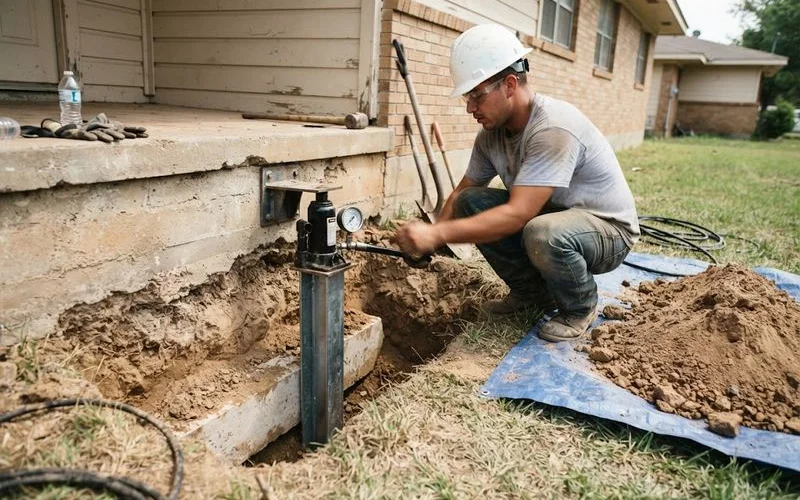
Depth. Shallow piers can follow the same seasonal soil movement that caused the problem. Ask each company how deep it plans to go and what it is bearing on.
Access. Pressed and steel piers are installed from the exterior perimeter and, for interior beams, through tunnels or openings. Drilled piers need equipment room.
Disturbance. Expect trenching along the slab edge for most methods, plus some patching of flooring if the slab is lifted.
Common questions that come up in the field
Homeowners often ask whether a slab with a post-tension cable system can take piers. It depends, and the engineer needs to know the cable layout before anyone drills. The glossary has a short entry on post-tension slabs. If your house has one, say so when you request quotes and ask how the company will avoid the tendons.
Another common question is whether piers stop movement forever. They give the slab deeper support, but the soil above still moves with moisture. Good drainage and some monitoring remain part of owning the house.
Lift targets and cosmetic work
Expect the company to lift the slab to a target rather than to perfect level, because lifting too far can crack the structure. Ask what elevation change the company aims for and how it will measure it. After the lift, doors may need adjusting, drywall cracks may need patching and tile may need repair. Those costs are often excluded from the base price.
Red flags in the method discussion
If a company cannot explain why a particular pier type fits your soil, ask again or ask for a second opinion. If the quote does not state the depth or the number of piers, it is not complete. And if you hear that one method is always the answer, that is a sales line, not an engineering position.
How to decide
- Get an independent engineer’s report that states the cause and a pier plan.
- Ask each company why its recommended type fits your soil and house.
- Compare warranty terms on the specific method, not just the company.
- Check whether the quote includes a plumbing test and post-lift measurements.
Reviewers in our data praise companies that explain findings plainly and call out disputed inspection findings as a frequent frustration. Both point to the same habit: make the company justify the method in writing.
For how we weigh reviews when ranking, see how we score. The home page lists every category. This is general information, not engineering advice.
Frequently asked questions
- Which pier type is best for a slab?
- There is no single best. Soil, load, depth and access decide. An engineer's report should explain the recommendation.
- Do steel piers cost more than concrete?
- In our estimator, steel carries about a 25 percent premium over pressed concrete and drilled piers about 15 percent. Real quotes vary.
- Will the slab go back to perfectly level?
- Often not fully. Ask what level of lift the company expects and how it will measure it.
- Can any method fix a drainage or plumbing cause?
- No. Piers support the slab. The water source needs its own fix.
Related on this site
- Browse slab foundation repair providers
- Do you need a structural engineer report before foundation repair?
- Pier and beam foundation repair: what to expect from start to finish
- Mudjacking vs foam leveling: which method fits your slab or driveway
- How poor drainage moves your foundation and what fixes it
- All guides →